


PTSD Terrain Restoration Program
From Fight-or-Flight to Strategic Self-Governance
PTSD is not weakness. It is not failure. It is not simply “bad memories.”
For many people, trauma becomes a whole-body survival state. The mind may know the danger is over, but the body keeps living as if the emergency is still happening. Sleep breaks down. The nervous system stays on guard. Motivation disappears. Pain and tension increase. Alcohol, cannabis, sugar, isolation, anger, or avoidance can become the quickest way to change state for a few hours.
The Absurd Health PTSD Terrain Restoration Program was built for people who feel trapped in that loop.
Our model begins with a simple idea: PTSD may be one diagnosis, but it does not show up the same way in every person. Some people live hyper-alert and wired. Some shut down and go numb. Some lose joy, drive, and future. Some carry deep relational wounds. Some feel trauma mostly through pain, tension, headaches, or gut distress. Others feel crushed by fatigue, inflammation, poor sleep, and body-wide depletion.
That difference matters, because the right treatment at the wrong time can fail.
A body stuck in alarm may not be ready for deep trauma work. A shutdown body may need nourishment and reconnection before intensity. A pain-dominant body may need its alarm system quieted before it can trust sensation again. A fatigue-heavy body may need sleep, minerals, protein, inflammation reduction, and metabolic stability before deeper restoration can begin.
This is why we do not begin with a one-size-fits-all plan.
We begin by mapping the terrain.
What the Program is Designed to Do

The PTSD Terrain Restoration Program is a structured wellness and care-sequencing model designed to support:
sleep restoration
nervous-system regulation
circadian rhythm repair
hydration and electrolyte balance
protein and mineral sufficiency
reduction of inflammatory burden
stabilization of body-alarm physiology
reduction of alcohol, cannabis, sugar, and relief-seeking loops
metabolic flexibility
strategic self-governance
readiness for deeper trauma processing when appropriate
The goal is not to erase memory. The goal is to help the body stop living as if trauma still has command.

Who This May Be For
This program may be especially relevant for people who have tried therapy, medication, support groups, or self-help, but still feel physically trapped in the same survival state.
It may be relevant if trauma shows up as:
constant vigilance
poor sleep
nightmares or night-body reactions
emotional numbness
loss of joy or motivation
chronic pain or body tension
fatigue and poor recovery
alcohol or cannabis reliance
sugar or food-based relief seeking
irritability, shutdown, or avoidance
feeling unable to plan a future
feeling like your body never left the emergency
Which PTSD Do You Have?
The program uses a trauma-pattern self-screen to help identify which survival state is most active right now.
Type 1: Hyper-Alert / Threat-Locked
The always-on-guard pattern. Vigilance, startle, tension, irritability, racing heart, poor sleep, and inability to relax.
Type 2: Shutdown / Dissociative
The numb, frozen, detached, inwardly disappeared pattern. The person may look calm outside while feeling far away inside.
Type 3: Flat / Reward-Collapsed
The low-joy, low-drive, gray, anhedonic pattern. Life feels muted. Motivation is weak. The future does not pull strongly enough.
Type 4: Complex / Developmental
The relational-injury pattern. Long-term shame, mistrust, rejection sensitivity, identity wounds, and difficulty feeling safe with people.
Type 5: Somatic / Pain-Dominant
The body-amplified pattern. Pain, headaches, gut symptoms, chronic tension, guarding, bracing, and overwhelming internal sensations.
Type 6: Fatigue / Inflammatory-Metabolic
The depleted, heavy, crash-prone pattern. Poor recovery, fog, unrefreshing sleep, immune-like burden, and worsening with illness or exhaustion.
Most people are not just one type. Many have overlap. The point is not to put you in a box. The point is to stop guessing.
Why Metabolism Matters in PTSD
Many people with chronic PTSD are not only dealing with fear. They are dealing with a body that has lost rhythm.
Sleep is broken. Reward is distorted. Inflammation may be elevated. Pain becomes louder. The body demands relief. The nervous system keeps reaching for anything that can change the state quickly: food, sugar, alcohol, cannabis, nicotine, rage, isolation, scrolling, or avoidance.
This is what we call short-horizon survival.
The body is no longer asking, “What will build my life over the next year?”
It is asking, “What will make this feeling stop right now?”
The Absurd Health model is designed to help move a person from short-horizon survival into strategic self-governance. That means rebuilding the body’s ability to tolerate discomfort, delay reward, sleep deeply, recover, plan, and act from purpose instead of reflex.

The Neuroketotic Capstone
For some prepared adults, the program may include a carefully screened neuroketotic fasting phase.
This is not the starting point. It is not for everyone. It is never approved by a questionnaire alone. Prolonged fasting is a physiologic stressor and requires medical screening, medication review, readiness assessment, stop criteria, and refeed planning.
When appropriate, the purpose of the neuroketotic phase is to shift the body away from constant external state-change dependency and toward internal reserve. In a deeper ketone-supported state, the body may experience old signals—hunger, craving, fear, agitation, tension, memory, discomfort—without obeying the old relief pattern.
The fast is not punishment. It is not spectacle. It is not a claim that PTSD is “cured” by not eating.
It is a capstone intervention designed to create a temporary window where the old survival loops may lose some of their command.
But the real work is what comes before and after: stabilization, safety, refeed, sleep, nourishment, integration, and rebuilding life structure.
Download the Free White Paper
For clinicians, veterans, trauma survivors, families, and serious readers, we have prepared a free white paper explaining the rationale behind the PTSD Terrain Restoration model.
Inside the white paper, you will learn:
why PTSD should be understood as one diagnosis with multiple dominant terrain patterns
how trauma can trap the body in short-horizon survival
why sleep, inflammation, reward, pain, fatigue, and metabolic instability matter
how alcohol, cannabis, sugar, and other relief loops can become state-change dependencies
what neuroketotic metabolism may offer as a carefully screened capstone intervention
why fasting must never be treated as casual, universal, or unsupervised
how the Absurd Health model sequences stabilization, terrain mapping, metabolic readiness, capstone intervention, and refeed

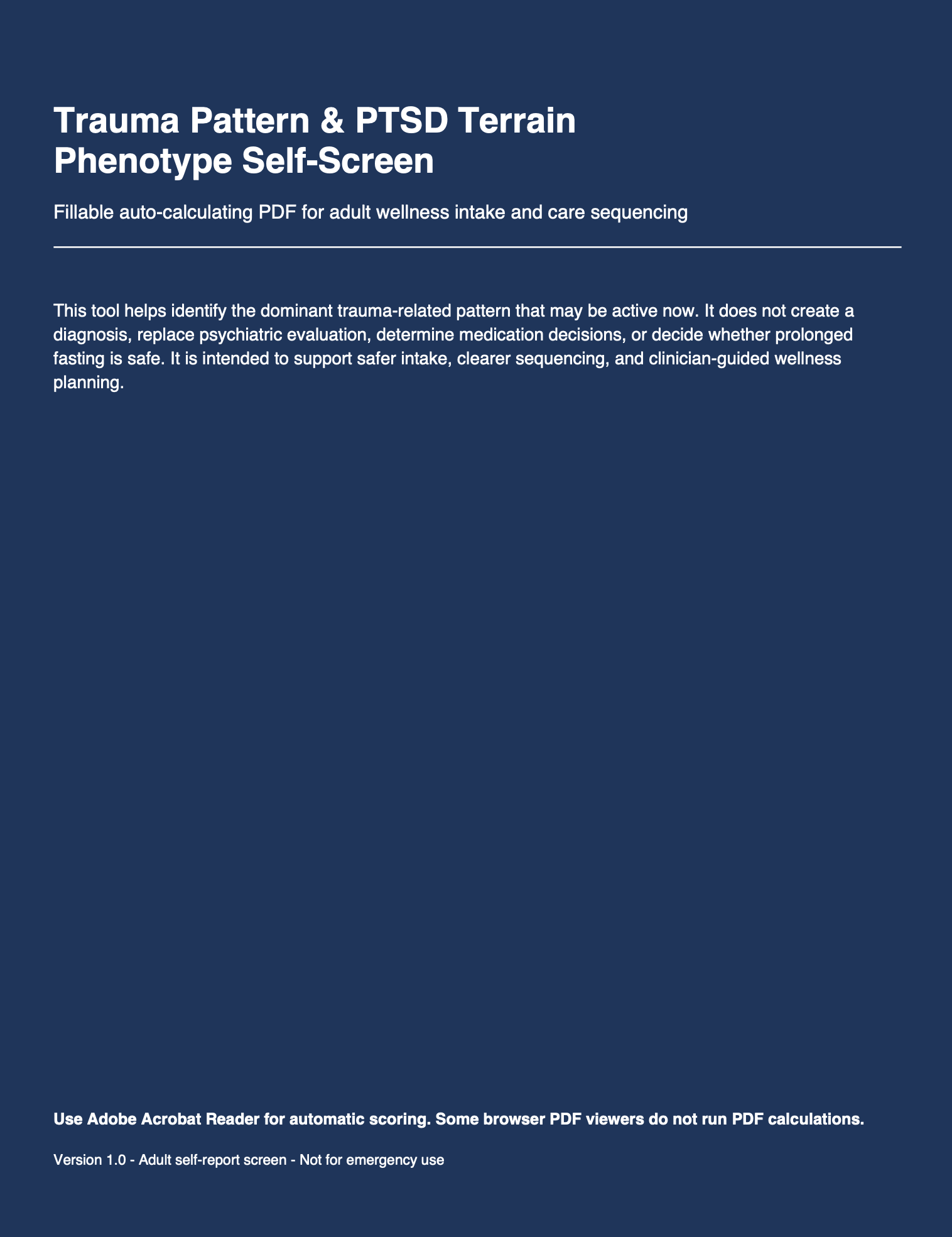
Take the Trauma Pattern Self-Screen
We also offer a PTSD Terrain Phenotype Self-Screen to help identify which trauma pattern may be most active right now.
This screen does not diagnose PTSD. It does not replace psychiatric care. It does not determine whether fasting is safe. It is designed to support intake, education, and better care sequencing.
The screen helps organize your current pattern across six major trauma terrains, plus physiology modifiers such as sleep, autonomic alarm, energy, inflammation, somatic tension, and mixed-state shifting.
Not all PTSD subtypes are treatable with this protocol. We specialize in treating PTSD which dominates in Type 1, 3, 5 and 6.
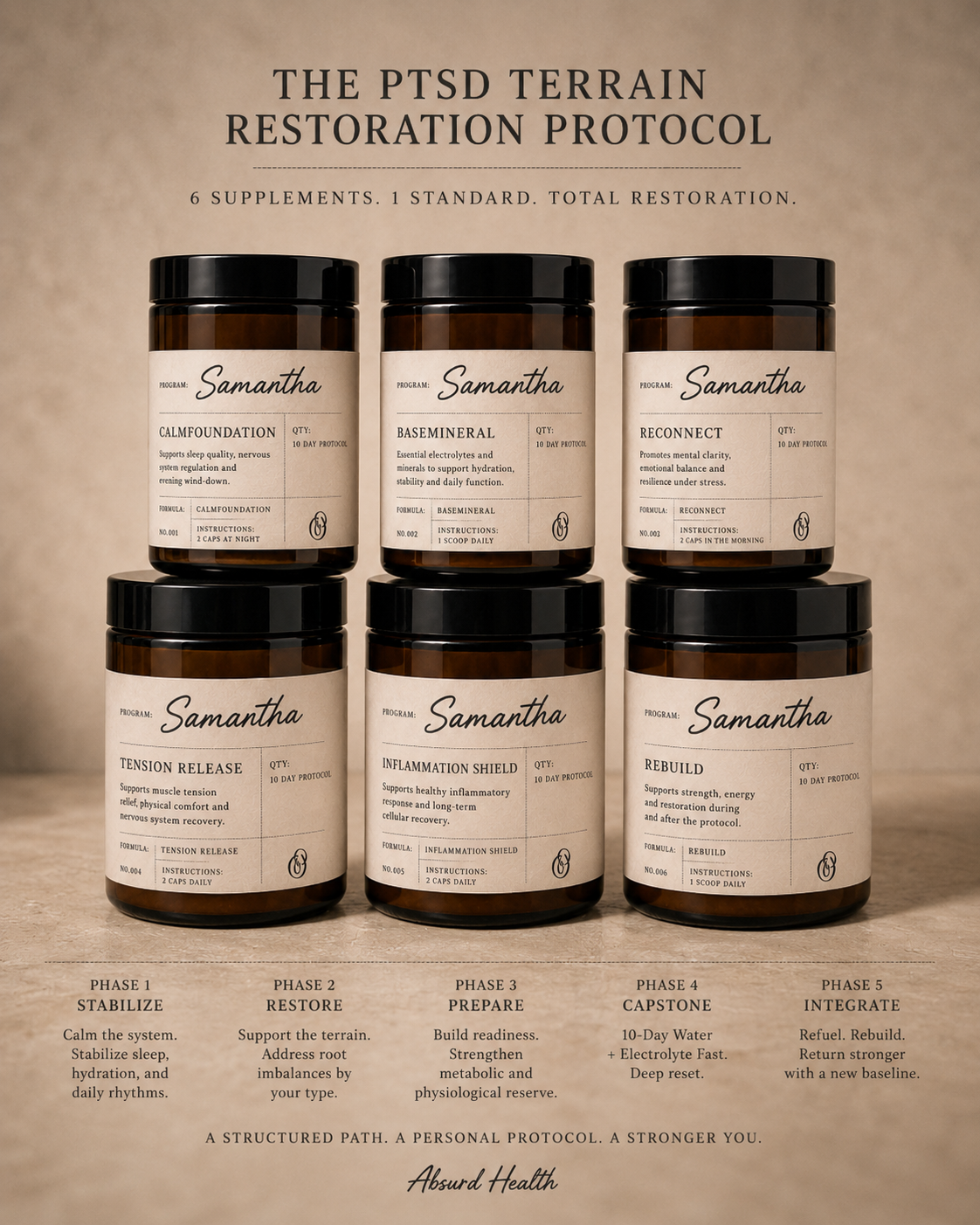
Start the PTSD Terrain Restoration Protocol
The goal is not just to manage symptoms.
The goal is to recover command over your body, your choices, your sleep, your future, and your life.
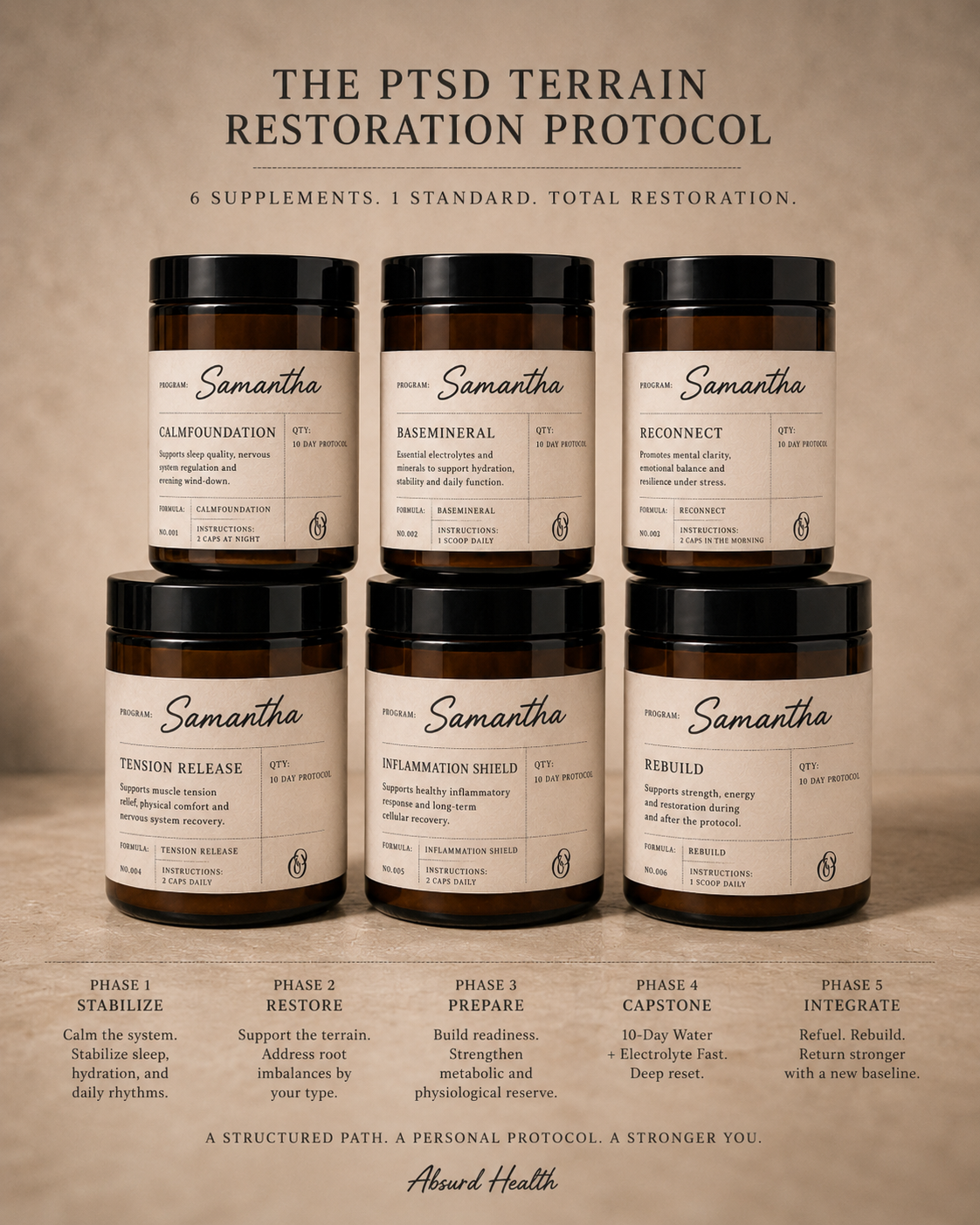
The cost for the program is $595 with free shipping to USA, Mexico and Canada. International shipping available for a small fee.
A New Way to Approach Trauma Recovery
PTSD is not just a memory problem.
For many people, trauma becomes a body-wide survival state. The nervous system stays on guard. Sleep breaks. Motivation disappears. Pain increases. The body reaches for relief through alcohol, cannabis, sugar, isolation, anger, or avoidance.
The Absurd Health PTSD Terrain Restoration Protocol is designed to help interrupt that cycle.
This is not a one-size-fits-all trauma program. We begin by identifying your dominant PTSD terrain: alarm, shutdown, reward collapse, complex relational trauma, somatic pain, or inflammatory fatigue. Then we build the protocol around what your body is actually doing.
What the Protocol Focuses On
The protocol is designed to support:
sleep and circadian repair
nervous-system regulation
mineral and electrolyte restoration
protein and nutrient sufficiency
reduction of inflammatory burden
metabolic stability
reduction of relief-seeking loops
improved self-control and future planning
readiness for deeper trauma work
For some prepared adults, the protocol may include a carefully screened neuroketotic fasting phase. This is not for everyone, and it is never treated casually. The purpose is to help the body move from constant external relief-seeking toward internal reserve and strategic self-governance.
Who This Is For
This protocol may be a fit if trauma has left you feeling:
always on guard
unable to sleep deeply
numb or emotionally shut down
flat, joyless, or unmotivated
trapped in pain or body tension
exhausted, foggy, or inflamed
dependent on alcohol, cannabis, sugar, or avoidance for relief
unable to move forward even after trying therapy or other approaches
What Makes This Different
Most PTSD care starts with the mind.
We start with the terrain.
If the body is exhausted, inflamed, sleepless, reward-collapsed, or stuck in alarm, deeper trauma work may not land. The protocol helps stabilize the body first, then builds toward deeper restoration.
This is not about forcing yourself to “get over it.”
It is about helping your body stop living as if the emergency is still happening.
Start the PTSD Terrain Restoration Protocol
Important Safety Note
This program is not emergency care. It does not replace psychiatric treatment, trauma therapy, medication management, addiction care, or physician-directed medical care.
If you are in crisis, feel unsafe, may harm yourself or someone else, are experiencing severe withdrawal, mania, psychosis, dangerous confusion, chest pain, fainting, or another urgent medical problem, seek emergency care immediately or contact the 988 Suicide & Crisis Lifeline in the United States.
Prolonged fasting is not appropriate for everyone. Anyone with pregnancy, breastfeeding, eating-disorder history, underweight status, unstable diabetes, insulin or sulfonylurea use, recurrent hypoglycemia, kidney disease, significant liver disease, heart disease, seizure disorder, active withdrawal risk, severe psychiatric instability, medication risks, or inability to maintain hydration and electrolytes requires careful clinician review before any intensive intervention.