

 Image 1 of 1
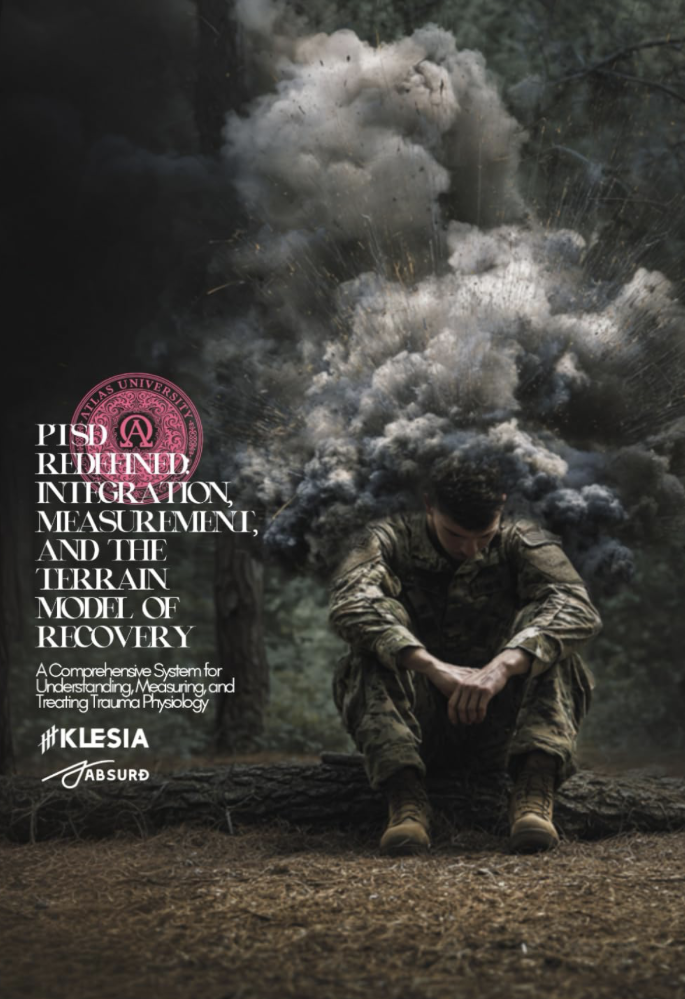
PTSD REDEFINED
Integration, Measurement, and the Terrain Model of Recovery
A Comprehensive System for Understanding, Measuring, and Treating Trauma Physiology
Most trauma models ask the wrong question.
They ask how to reduce symptoms.
This book asks something far more dangerous:
Why does the system stay broken in the first place?
PTSD Redefined is not another theory about memory, emotion, or coping.
It is a complete reconstruction of what trauma actually is.
The Failure of Everything You’ve Been Told
For decades, PTSD has been defined by symptoms:
Intrusive thoughts.
Avoidance.
Hypervigilance.
Emotional numbness.
But symptoms are not causes.
They are outputs.
And treating outputs without understanding the system that generates them guarantees one outcome:
Temporary relief… followed by relapse.
This book dismantles the symptom-based model entirely and replaces it with something far more precise — and far more actionable.
Trauma Is Not a Memory Problem
You can understand your trauma.
You can process your trauma.
You can talk about your trauma.
And still not be free.
Why?
Because trauma is not stored primarily as a story.
It is stored as a state.
A full-body reorganization of:
Nervous system function
Hormonal rhythm
Immune signaling
Metabolic stability
Sleep architecture
Perception itself
Your body is not remembering danger.
It is still living in it.
The Terrain Model: A New Foundation
At the center of this book is a radical shift:
PTSD is a disorder of integration capacity.
Not just psychology.
Not just biology.
But the coordination of the entire organism.
When integration fails:
The brain says “safe”
The body says “danger”
Systems fall out of sync
Recovery stalls
This model explains what others cannot:
Why two people with the same trauma heal differently
Why therapy works for some and fails for others
Why symptoms shift, mutate, and persist
Why progress can suddenly collapse
Because the issue was never just the mind.
It was the system.
From Guesswork to Measurement
This book does something most trauma frameworks avoid:
It makes recovery measurable.
Instead of relying only on subjective experience, it introduces objective markers of progress:
Heart rate variability
Sleep architecture
Hormonal rhythms
Inflammatory signals
Metabolic stability
For the first time, trauma recovery becomes something you can track, predict, and optimize.
Sequencing: The Missing Piece in Healing
One of the most overlooked truths in trauma care:
Not all interventions work at all times.
This book shows why:
You cannot process trauma in a dysregulated body
You cannot stabilize emotion without metabolic support
You cannot build resilience on a fractured foundation
Recovery must follow sequence:
Stabilize → Restore → Integrate → Expand
Without sequence, even the best therapies fail.
With it, progress becomes inevitable.
Trauma is not mysterious.
It is measurable.
It is structured.
And it is reversible — when you understand the system.
This is where PTSD stops being a label…
and becomes a solvable problem.
PTSD REDEFINED
Integration, Measurement, and the Terrain Model of Recovery
A Comprehensive System for Understanding, Measuring, and Treating Trauma Physiology
Most trauma models ask the wrong question.
They ask how to reduce symptoms.
This book asks something far more dangerous:
Why does the system stay broken in the first place?
PTSD Redefined is not another theory about memory, emotion, or coping.
It is a complete reconstruction of what trauma actually is.
The Failure of Everything You’ve Been Told
For decades, PTSD has been defined by symptoms:
Intrusive thoughts.
Avoidance.
Hypervigilance.
Emotional numbness.
But symptoms are not causes.
They are outputs.
And treating outputs without understanding the system that generates them guarantees one outcome:
Temporary relief… followed by relapse.
This book dismantles the symptom-based model entirely and replaces it with something far more precise — and far more actionable.
Trauma Is Not a Memory Problem
You can understand your trauma.
You can process your trauma.
You can talk about your trauma.
And still not be free.
Why?
Because trauma is not stored primarily as a story.
It is stored as a state.
A full-body reorganization of:
Nervous system function
Hormonal rhythm
Immune signaling
Metabolic stability
Sleep architecture
Perception itself
Your body is not remembering danger.
It is still living in it.
The Terrain Model: A New Foundation
At the center of this book is a radical shift:
PTSD is a disorder of integration capacity.
Not just psychology.
Not just biology.
But the coordination of the entire organism.
When integration fails:
The brain says “safe”
The body says “danger”
Systems fall out of sync
Recovery stalls
This model explains what others cannot:
Why two people with the same trauma heal differently
Why therapy works for some and fails for others
Why symptoms shift, mutate, and persist
Why progress can suddenly collapse
Because the issue was never just the mind.
It was the system.
From Guesswork to Measurement
This book does something most trauma frameworks avoid:
It makes recovery measurable.
Instead of relying only on subjective experience, it introduces objective markers of progress:
Heart rate variability
Sleep architecture
Hormonal rhythms
Inflammatory signals
Metabolic stability
For the first time, trauma recovery becomes something you can track, predict, and optimize.
Sequencing: The Missing Piece in Healing
One of the most overlooked truths in trauma care:
Not all interventions work at all times.
This book shows why:
You cannot process trauma in a dysregulated body
You cannot stabilize emotion without metabolic support
You cannot build resilience on a fractured foundation
Recovery must follow sequence:
Stabilize → Restore → Integrate → Expand
Without sequence, even the best therapies fail.
With it, progress becomes inevitable.
Trauma is not mysterious.
It is measurable.
It is structured.
And it is reversible — when you understand the system.
This is where PTSD stops being a label…
and becomes a solvable problem.