

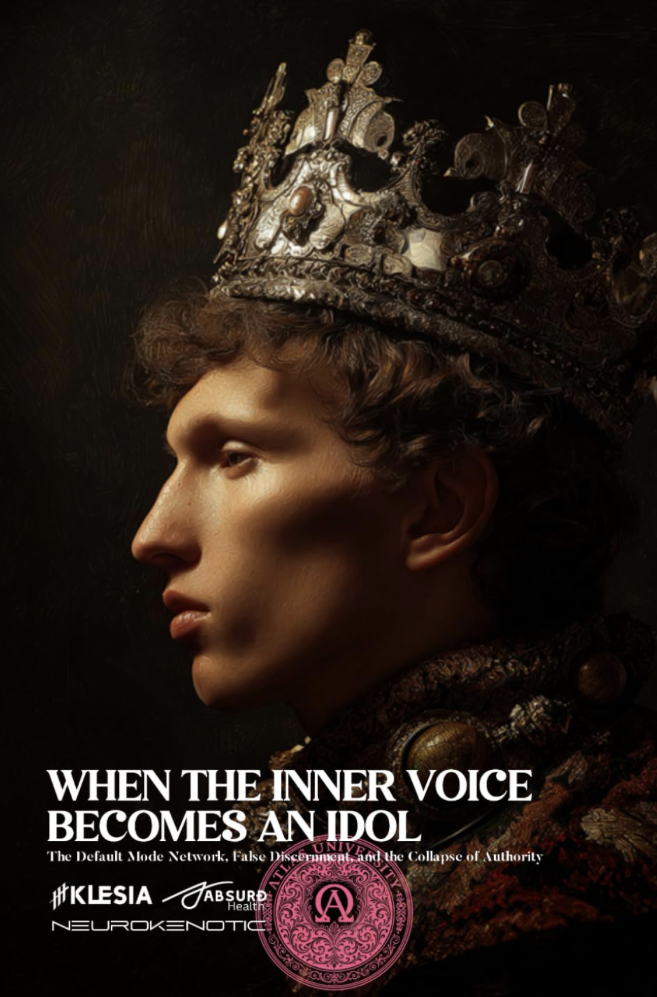
 Image 1 of 1
When the Inner Voice Becomes an Idol
The Default Mode Network, False Discernment, and the Collapse of Authority
Modern people listen to themselves more than any civilization in history.
They analyze their thoughts.
They interrogate their feelings.
They track their inner states.
They wait for “clarity,” “resonance,” or “peace” before acting.
And yet, despite all this inward attention, decisiveness has collapsed, obedience has vanished, anxiety has become ambient, and discernment has quietly disintegrated.
When the Inner Voice Becomes an Idol exposes the hidden neurological and spiritual error beneath this condition: the elevation of internal narration to the status of authority.
At the center of the modern mind is a system neuroscience now calls the Default Mode Network—the brain network responsible for self-referential thought, autobiographical memory, imagined futures, and social simulation. This network is not evil. It is necessary. But it was never meant to rule. It was designed to operate in the background, integrating experience after action—not governing perception, decision-making, or moral judgment in real time.
This book makes a precise and unsettling claim:
Much of what modern culture calls intuition, conscience, discernment, or even “hearing God” is actually unregulated Default Mode Network activity.
The result is catastrophic confusion.
Thought is mistaken for awareness.
Narration is mistaken for wisdom.
Emotional certainty is mistaken for truth.
And internal noise is mistaken for the voice of Yahweh.
Drawing together neuroscience, clinical psychology, biblical anthropology, and spiritual theology, this book dismantles the assumption that the loudest inner voice is the truest one. It shows how constant self-narration fragments attention, amplifies anxiety, fuels depression, hardens identity stories, and replaces obedience with endless interpretation. It explains why modern people feel perpetually “processing” but rarely moving, endlessly discerning but rarely deciding, constantly listening but rarely obeying.
Crucially, this work does not demonize the mind, dismiss psychology, or retreat into anti-intellectualism. Mental illness is addressed without moralism, shame, or spiritual bypassing. Obsessive-compulsive disorder, anxiety, depression, bipolar states, and psychotic experiences are examined with clinical clarity and theological restraint. The book draws a hard line between inner experience and divine authority, protecting both the dignity of the suffering and the holiness of Yahweh from dangerous conflation.
Throughout the book, a consistent biblical pattern emerges:
Yahweh does not speak through incessant narration.
He does not negotiate with the self.
He does not flatter identity.
His voice interrupts rather than loops, commands rather than explains, and produces obedience rather than introspection.
When the Inner Voice Becomes an Idol
The Default Mode Network, False Discernment, and the Collapse of Authority
Modern people listen to themselves more than any civilization in history.
They analyze their thoughts.
They interrogate their feelings.
They track their inner states.
They wait for “clarity,” “resonance,” or “peace” before acting.
And yet, despite all this inward attention, decisiveness has collapsed, obedience has vanished, anxiety has become ambient, and discernment has quietly disintegrated.
When the Inner Voice Becomes an Idol exposes the hidden neurological and spiritual error beneath this condition: the elevation of internal narration to the status of authority.
At the center of the modern mind is a system neuroscience now calls the Default Mode Network—the brain network responsible for self-referential thought, autobiographical memory, imagined futures, and social simulation. This network is not evil. It is necessary. But it was never meant to rule. It was designed to operate in the background, integrating experience after action—not governing perception, decision-making, or moral judgment in real time.
This book makes a precise and unsettling claim:
Much of what modern culture calls intuition, conscience, discernment, or even “hearing God” is actually unregulated Default Mode Network activity.
The result is catastrophic confusion.
Thought is mistaken for awareness.
Narration is mistaken for wisdom.
Emotional certainty is mistaken for truth.
And internal noise is mistaken for the voice of Yahweh.
Drawing together neuroscience, clinical psychology, biblical anthropology, and spiritual theology, this book dismantles the assumption that the loudest inner voice is the truest one. It shows how constant self-narration fragments attention, amplifies anxiety, fuels depression, hardens identity stories, and replaces obedience with endless interpretation. It explains why modern people feel perpetually “processing” but rarely moving, endlessly discerning but rarely deciding, constantly listening but rarely obeying.
Crucially, this work does not demonize the mind, dismiss psychology, or retreat into anti-intellectualism. Mental illness is addressed without moralism, shame, or spiritual bypassing. Obsessive-compulsive disorder, anxiety, depression, bipolar states, and psychotic experiences are examined with clinical clarity and theological restraint. The book draws a hard line between inner experience and divine authority, protecting both the dignity of the suffering and the holiness of Yahweh from dangerous conflation.
Throughout the book, a consistent biblical pattern emerges:
Yahweh does not speak through incessant narration.
He does not negotiate with the self.
He does not flatter identity.
His voice interrupts rather than loops, commands rather than explains, and produces obedience rather than introspection.