

 Image 1 of 1
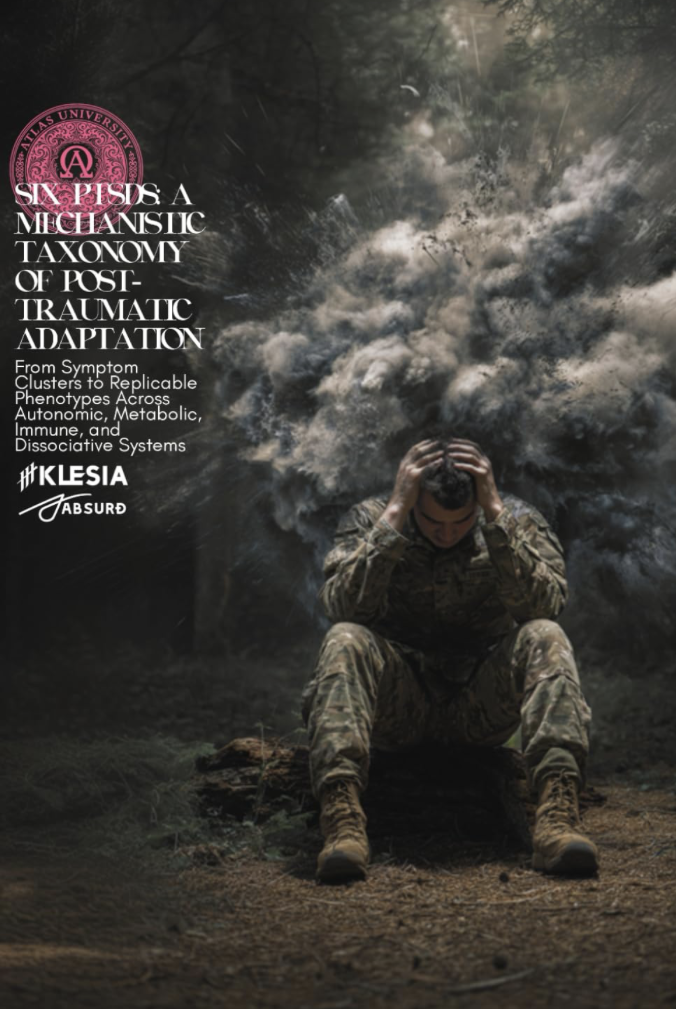
THE SIX PTSDs: A Mechanistic Taxonomy of Post-Traumatic Adaptation: From Symptom Clusters to Replicable Phenotypes Across Autonomic, Metabolic, Immune, and Dissociative Systems
SIX PTSDs
A Mechanistic Taxonomy of Post-Traumatic Adaptation
The problem with PTSD is not that it is misunderstood.
It is that it has been oversimplified.
Six PTSDs challenges one of the most entrenched assumptions in modern psychiatry: that post-traumatic stress disorder is a single condition with a unified biological basis. Drawing from decades of fragmented research, this book makes a decisive claim:
PTSD is not one disorder.
It is a category hiding multiple distinct biological realities.
SIX PTSDs- A Mechanistic Taxono…
The Hidden Crisis in Trauma Science
For years, clinicians and researchers have struggled with contradictions:
Treatments that work for some patients fail for others.
Biomarker studies produce inconsistent results.
Symptoms vary wildly across individuals.
This book reveals why.
The issue is not weak science — it is misclassification.
By forcing fundamentally different adaptation patterns into a single diagnostic label, the field has unintentionally created confusion, noise, and treatment inefficiency.
A Radical Reframe: From Disorder to Adaptation
Instead of treating PTSD as pathology alone, Six PTSDs reframes it as adaptive response under extreme stress — a reorganization of the human organism across multiple systems:
Autonomic regulation (fight, flight, shutdown)
Metabolic and energetic capacity
Immune signaling and inflammation
Dissociative processes
Reward and motivation systems
Each pattern represents a distinct survival strategy, not a variation of the same condition.
The Six-Type Model
At the core of this work is a parsimonious but powerful taxonomy:
Six recurring, biologically grounded phenotypes of post-traumatic adaptation.
These are not abstract categories or symptom clusters. They are:
Replicable patterns of regulation
Distinct physiological states
Predictable trajectories over time
Differentiated responses to treatment
This framework moves trauma science beyond description — toward prediction.
Why Current Treatments Fall Short
When different biological states are treated as one condition, outcomes become inconsistent.
What stabilizes one individual may destabilize another.
This book shows why:
Exposure therapy may help hyperarousal but worsen dissociation
Cognitive approaches may fail in metabolically exhausted states
Pharmacology produces mixed results due to hidden subtype differences
Without typology, treatment becomes guesswork.
With typology, it becomes targeted intervention.
From Noise to Clarity
Many of the field’s greatest frustrations are reframed:
Inconsistent biomarker findings → mixed populations
Weak treatment effects → subtype mismatch
High comorbidity → phenotype expression across systems
What appears as chaos is actually structure waiting to be recognized.
A Framework Built to Be Tested
Unlike speculative models, Six PTSDs is constructed as a scientific program:
Each type is grounded in existing research traditions
Clear criteria for validation and falsification are defined
The model predicts measurable biological and clinical differences
Future studies can confirm, refine, or overturn it
This is not ideology.
It is a framework designed to survive scrutiny.
SIX PTSDs
A Mechanistic Taxonomy of Post-Traumatic Adaptation
The problem with PTSD is not that it is misunderstood.
It is that it has been oversimplified.
Six PTSDs challenges one of the most entrenched assumptions in modern psychiatry: that post-traumatic stress disorder is a single condition with a unified biological basis. Drawing from decades of fragmented research, this book makes a decisive claim:
PTSD is not one disorder.
It is a category hiding multiple distinct biological realities.
SIX PTSDs- A Mechanistic Taxono…
The Hidden Crisis in Trauma Science
For years, clinicians and researchers have struggled with contradictions:
Treatments that work for some patients fail for others.
Biomarker studies produce inconsistent results.
Symptoms vary wildly across individuals.
This book reveals why.
The issue is not weak science — it is misclassification.
By forcing fundamentally different adaptation patterns into a single diagnostic label, the field has unintentionally created confusion, noise, and treatment inefficiency.
A Radical Reframe: From Disorder to Adaptation
Instead of treating PTSD as pathology alone, Six PTSDs reframes it as adaptive response under extreme stress — a reorganization of the human organism across multiple systems:
Autonomic regulation (fight, flight, shutdown)
Metabolic and energetic capacity
Immune signaling and inflammation
Dissociative processes
Reward and motivation systems
Each pattern represents a distinct survival strategy, not a variation of the same condition.
The Six-Type Model
At the core of this work is a parsimonious but powerful taxonomy:
Six recurring, biologically grounded phenotypes of post-traumatic adaptation.
These are not abstract categories or symptom clusters. They are:
Replicable patterns of regulation
Distinct physiological states
Predictable trajectories over time
Differentiated responses to treatment
This framework moves trauma science beyond description — toward prediction.
Why Current Treatments Fall Short
When different biological states are treated as one condition, outcomes become inconsistent.
What stabilizes one individual may destabilize another.
This book shows why:
Exposure therapy may help hyperarousal but worsen dissociation
Cognitive approaches may fail in metabolically exhausted states
Pharmacology produces mixed results due to hidden subtype differences
Without typology, treatment becomes guesswork.
With typology, it becomes targeted intervention.
From Noise to Clarity
Many of the field’s greatest frustrations are reframed:
Inconsistent biomarker findings → mixed populations
Weak treatment effects → subtype mismatch
High comorbidity → phenotype expression across systems
What appears as chaos is actually structure waiting to be recognized.
A Framework Built to Be Tested
Unlike speculative models, Six PTSDs is constructed as a scientific program:
Each type is grounded in existing research traditions
Clear criteria for validation and falsification are defined
The model predicts measurable biological and clinical differences
Future studies can confirm, refine, or overturn it
This is not ideology.
It is a framework designed to survive scrutiny.