

 Image 1 of 1
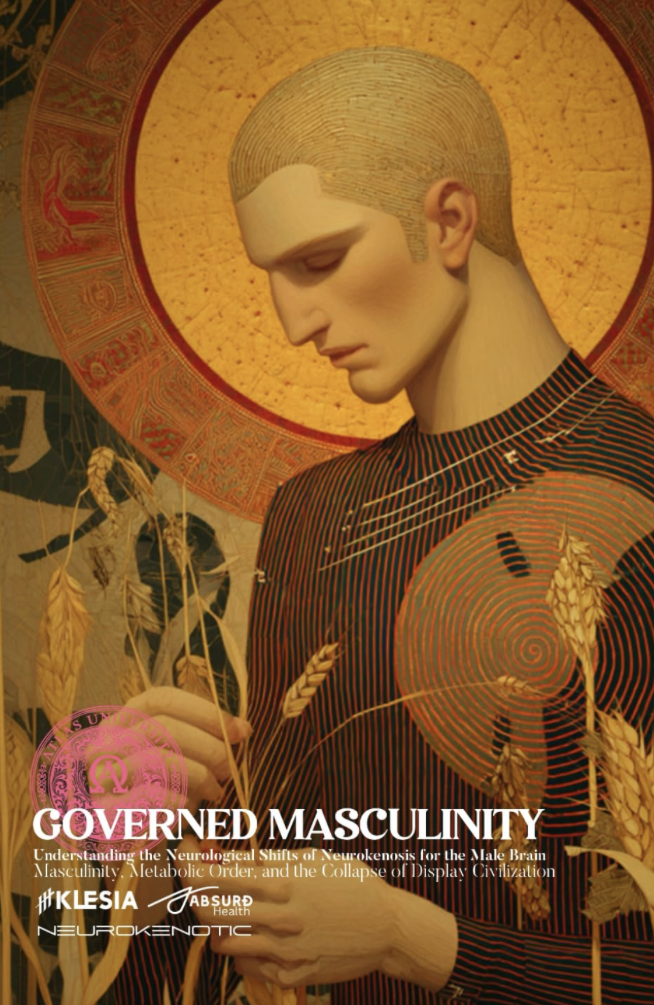
The Governed Man: Masculinity, Metabolic Order, and the Collapse of Display Civilization: Why Strength Begins with Restraint—and How Dopamine Destroyed Authority
Modern discourse endlessly diagnoses the crisis of masculinity—pointing to aggression, narcissism, restlessness, and moral failure as evidence that men have gone wrong. But beneath the cultural noise and psychological speculation lies a simpler and far more sobering reality: masculinity did not collapse because men became immoral. It collapsed because the biological foundation that made restraint possible quietly disappeared
This book does not begin with moral critique, ideological nostalgia, or calls to recover “traditional manhood.” It begins with a decisive claim: strength is not performance—it is regulation. Authority is not noise—it is the capacity to hold. Masculinity is not an identity—it is a regulatory state, built first and last on restraint.
Restraint, Not Expression
Across history, the defining trait of masculine power was not aggression, dominance, or endless motion. It was inhibition—the ability to wait, to hold, to absorb tension without collapse or outburst. For most of human history, men lived in environments of intermittent hunger, silence, and consequence. Under these conditions, the male nervous system evolved to value inhibition above expression. Action was costly. Noise was waste.
Masculinity was not loud because it needed attention; it was silent because it could afford to wait
When Regulation Collapsed
The modern world—through abundance, constant feeding, endless stimulation, and unrelenting demand—erased the conditions that allowed masculine restraint to flourish.
Dopamine volatility replaced metabolic rhythm.
Insulin and cortisol sabotaged androgen signaling.
Testosterone did not disappear; it was overruled.
Masculinity did not vanish, it mutated—seeking regulation not through inward calm, but outward display. Expression became the norm, not because men lost virtue, but because their bodies lost the architecture of restraint.
Display Civilization
Civilizations mirror the regulatory state of their dominant men. When inhibition collapses, societies become loud, performative, and brittle—rewarding visibility over competence, confidence over reliability, aggression over authority, and identity over substance. What was once quiet strength becomes compulsive performance.
The man is no longer governed from within; he is compelled to display.
Biological Truth, Not Ideology
This is not a call for moral re-education, ideological restraint, or performative confidence.
It is a return to the biological order:
— Dopamine, insulin, and cortisol must be quieted; androgen signaling restored; energy certainty rebuilt; and silence reclaimed as a condition, not a technique.
— Masculinity begins with the ability not to act—holding tension, delaying gratification, absorbing chaos, and radiating authority without needing to assert it.
Anatomy of Authority
Through rigorous exploration of evolutionary biology, neuroendocrinology, metabolism, sexuality, and civilizational dynamics, The Governed Man demonstrates that true strength is inhibitory before it is expressive. Testosterone, when integrated, does not incite aggression—it governs it. Silence, when restored, is not emptiness—it is unoccupied capacity. And inhibition, when rebuilt, is not suppression—it is the forgotten shape of authority.
Restoration Without Romance
This book dismantles the myth that masculinity is intensity, aggression, or ceaseless action.
It reveals that civilization itself was built—then lost—by the hands of men who could wait.
The Governed Man is written for those who are ready to set aside modern explanations and recover the biological architecture that once made masculine strength both reliable and rare. It is for clinicians, thinkers, men, and women who want to see masculinity restored—not as a spectacle, but as the silent pillar upon which order stands.
Modern discourse endlessly diagnoses the crisis of masculinity—pointing to aggression, narcissism, restlessness, and moral failure as evidence that men have gone wrong. But beneath the cultural noise and psychological speculation lies a simpler and far more sobering reality: masculinity did not collapse because men became immoral. It collapsed because the biological foundation that made restraint possible quietly disappeared
This book does not begin with moral critique, ideological nostalgia, or calls to recover “traditional manhood.” It begins with a decisive claim: strength is not performance—it is regulation. Authority is not noise—it is the capacity to hold. Masculinity is not an identity—it is a regulatory state, built first and last on restraint.
Restraint, Not Expression
Across history, the defining trait of masculine power was not aggression, dominance, or endless motion. It was inhibition—the ability to wait, to hold, to absorb tension without collapse or outburst. For most of human history, men lived in environments of intermittent hunger, silence, and consequence. Under these conditions, the male nervous system evolved to value inhibition above expression. Action was costly. Noise was waste.
Masculinity was not loud because it needed attention; it was silent because it could afford to wait
When Regulation Collapsed
The modern world—through abundance, constant feeding, endless stimulation, and unrelenting demand—erased the conditions that allowed masculine restraint to flourish.
Dopamine volatility replaced metabolic rhythm.
Insulin and cortisol sabotaged androgen signaling.
Testosterone did not disappear; it was overruled.
Masculinity did not vanish, it mutated—seeking regulation not through inward calm, but outward display. Expression became the norm, not because men lost virtue, but because their bodies lost the architecture of restraint.
Display Civilization
Civilizations mirror the regulatory state of their dominant men. When inhibition collapses, societies become loud, performative, and brittle—rewarding visibility over competence, confidence over reliability, aggression over authority, and identity over substance. What was once quiet strength becomes compulsive performance.
The man is no longer governed from within; he is compelled to display.
Biological Truth, Not Ideology
This is not a call for moral re-education, ideological restraint, or performative confidence.
It is a return to the biological order:
— Dopamine, insulin, and cortisol must be quieted; androgen signaling restored; energy certainty rebuilt; and silence reclaimed as a condition, not a technique.
— Masculinity begins with the ability not to act—holding tension, delaying gratification, absorbing chaos, and radiating authority without needing to assert it.
Anatomy of Authority
Through rigorous exploration of evolutionary biology, neuroendocrinology, metabolism, sexuality, and civilizational dynamics, The Governed Man demonstrates that true strength is inhibitory before it is expressive. Testosterone, when integrated, does not incite aggression—it governs it. Silence, when restored, is not emptiness—it is unoccupied capacity. And inhibition, when rebuilt, is not suppression—it is the forgotten shape of authority.
Restoration Without Romance
This book dismantles the myth that masculinity is intensity, aggression, or ceaseless action.
It reveals that civilization itself was built—then lost—by the hands of men who could wait.
The Governed Man is written for those who are ready to set aside modern explanations and recover the biological architecture that once made masculine strength both reliable and rare. It is for clinicians, thinkers, men, and women who want to see masculinity restored—not as a spectacle, but as the silent pillar upon which order stands.