

 Image 1 of 1
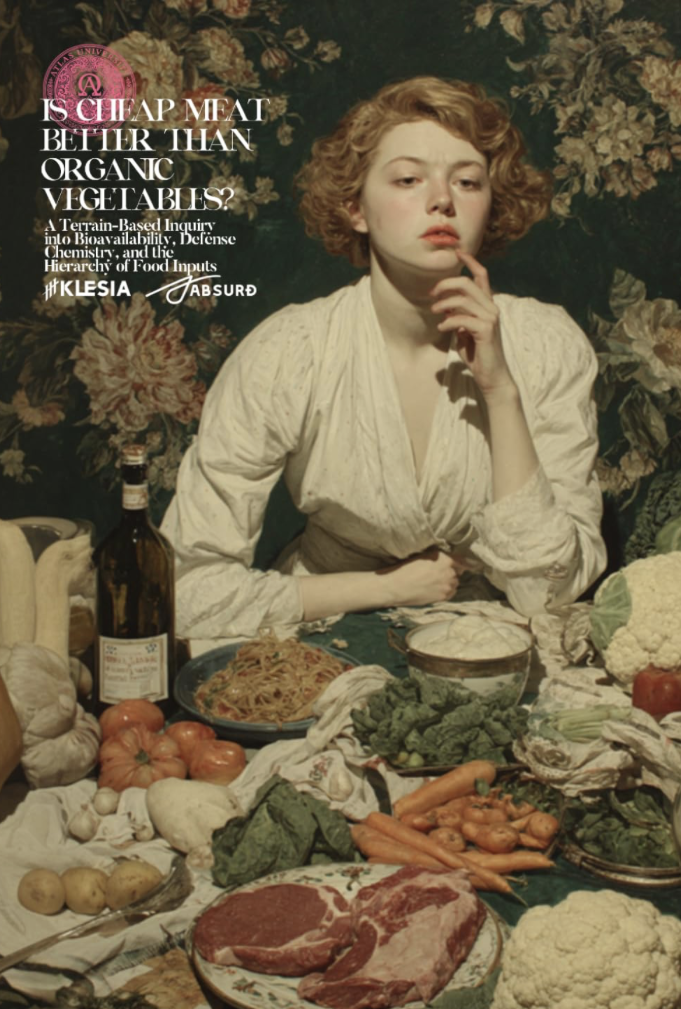
IS CHEAP MEAT BETTER THAN ORGANIC VEGETABLES?
A Terrain-Based Inquiry into Bioavailability, Defense Chemistry, and the Hierarchy of Food Inputs
What if the healthiest food choice is not the one with the cleanest label?
What if the real question is not what looks best in the grocery store—
but what your body can actually digest, absorb, and use with the least internal cost?
This book confronts one of the most uncomfortable questions in modern nutrition.
Not the idealized version.
The real one.
The question ordinary people face when budgets are limited, health is fragile, and food choices must be made in the middle of confusion, marketing, and contradiction.
The Question Most Nutrition Experts Avoid
Modern nutrition is full of slogans.
Eat more plants.
Buy organic.
Avoid red meat.
Prioritize fiber.
Trust nutrient density.
Fear toxins.
Fear fat.
Fear deficiency.
Fear everything.
But the body does not run on slogans.
It runs on what it can break down, absorb, convert, and incorporate into tissue without provoking unnecessary inflammation, digestive strain, oxidative stress, and immune disruption.
This book changes the frame completely.
A Different Standard of “Better”
Instead of asking which foods sound cleaner, trendier, or more morally approved, this book asks a much harder question:
Which food imposes the least cost for the greatest usable return?
That means looking at food through a terrain-based lens:
digestive workload
bile demand
nutrient bioavailability
plant defense chemistry
metabolic friction
inflammatory burden
real-world yield inside the organism
In that framework, the comparison between cheap meat and organic vegetables becomes far more surprising—and far more honest.
Beyond Food Ideology
This is not a vegan book.
It is not a carnivore manifesto.
It is a direct challenge to the tribal thinking that dominates food culture.
Because both sides often miss the same truth:
A food can look healthy on paper and still be a high-cost burden inside the body.
A food can be imperfect, cheap, and unfashionable—and still offer a better biological return.
IS CHEAP MEAT BETTER THAN ORGANIC VEGETABLES?
A Terrain-Based Inquiry into Bioavailability, Defense Chemistry, and the Hierarchy of Food Inputs
What if the healthiest food choice is not the one with the cleanest label?
What if the real question is not what looks best in the grocery store—
but what your body can actually digest, absorb, and use with the least internal cost?
This book confronts one of the most uncomfortable questions in modern nutrition.
Not the idealized version.
The real one.
The question ordinary people face when budgets are limited, health is fragile, and food choices must be made in the middle of confusion, marketing, and contradiction.
The Question Most Nutrition Experts Avoid
Modern nutrition is full of slogans.
Eat more plants.
Buy organic.
Avoid red meat.
Prioritize fiber.
Trust nutrient density.
Fear toxins.
Fear fat.
Fear deficiency.
Fear everything.
But the body does not run on slogans.
It runs on what it can break down, absorb, convert, and incorporate into tissue without provoking unnecessary inflammation, digestive strain, oxidative stress, and immune disruption.
This book changes the frame completely.
A Different Standard of “Better”
Instead of asking which foods sound cleaner, trendier, or more morally approved, this book asks a much harder question:
Which food imposes the least cost for the greatest usable return?
That means looking at food through a terrain-based lens:
digestive workload
bile demand
nutrient bioavailability
plant defense chemistry
metabolic friction
inflammatory burden
real-world yield inside the organism
In that framework, the comparison between cheap meat and organic vegetables becomes far more surprising—and far more honest.
Beyond Food Ideology
This is not a vegan book.
It is not a carnivore manifesto.
It is a direct challenge to the tribal thinking that dominates food culture.
Because both sides often miss the same truth:
A food can look healthy on paper and still be a high-cost burden inside the body.
A food can be imperfect, cheap, and unfashionable—and still offer a better biological return.